Links to My Vacation Journals and Destinations

Looking for something in this blog?

Exploring the scenic Lotus Pond (蓮池潭) in the Zuoying district, Kaohsiung

30 March 2024      

The scenic Lotus Pond (蓮池潭) in the Zuoying district (situated in the northern part of the Kaohsiung) is worth a visit. The pond is a popular tourist destination and is well known for the pagodas, pavilions, and temples dotting the shoreline and nearby alleys.  

We had an afternoon for sightseeing at the Lotus Pond scenic area. The whole area is quite large but we are focusing on seeing only the following: the Confucius Temple, Tiger and Dragon Pagodas, Zuoying Yuandi Temple and the Spring and Summer Pavilions. Unfortunately, the Tiger and Dragon Pagodas were undergoing renovations and temporarily closed during our visit.

Tourist map of the Lotus Pond Scenic Area.

We took a taxi to the Confucius Temple which is situated on the northern bank of Lianchihtan (Lotus Pond). The plan was to walk southwards along the shores, visiting the various attractions along the way till the Tiger and Dragon Pagodas.


Confucius Temple

The Confucius Temple is dedicated to the memory of Confucius, China's most influential philosopher. The Confucius Temple is really impressive and I go wow at first sight of the main building.

It really looks like an imperial palace.

The Confucius Temple is built in imitation of Song Dynasty architecture, in the mold of Qufu Temple in Shandong and it was completed in 1976. This is the largest Confucius Temple in Taiwan and could pass off as an imperial palace. It looks like the Hall of Supreme Harmony of the Forbidden Palace in Beijing.

  We were the only visitors inside the main Dacheng Hall.

Tablet of Confucious in the Dacheng Hall.

Lantern with the character (師). Confucius is known as a teacher or master.

A large fan with 4 Chinese characters that read “The Teacher for Ages”.

  More artifacts on display. This place is like a museum.

  This is a musical instrument called the paixiao with a series of 16 bamboo tubes secured together. This wind instrument is also called the fengxiao or phoenix xiao.

Well decorated pathway leading to buildings on both sides of the main hall.

Tablets of Confucius’s disciplines and Confucian scholars are placed in the side buildings.

Leaving the temple, we headed south towards the pond. We passed through the main gate and an arch bridge over a semi-circular pond.  

  Main gate of the Confucius Temple. We actually entered through a side gate to the Main Hall and exited from this gate.

Entrance to the Confucius Temple facing the Lotus Pond. 

Chingshui Temple

There is a large temple with grey figure of a Buddhist monk perched on the roof across the Lotus Pond. We did not visit this temple as it is located on the eastern shore of the pond.

Chingshui Temple on the eastern shore.

Zuoying Yuandi Temple.

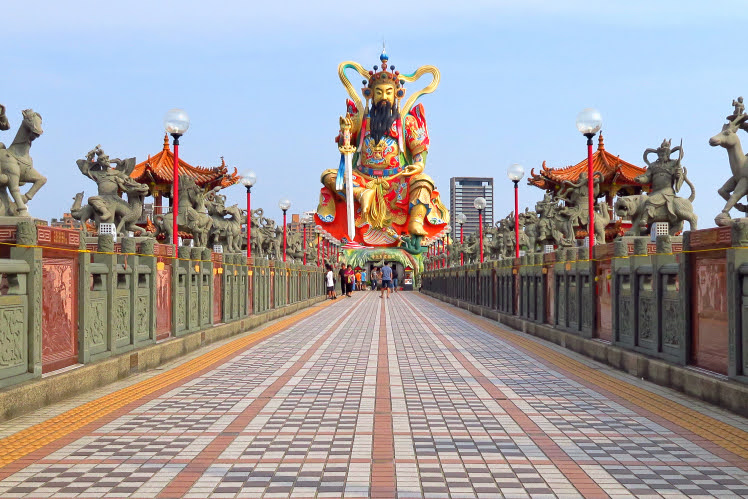
We walked on southwards, along the western shore of the Lotus Pond to a temple with a large colourful figure built over the water. This is the Zuoying Yuandi Temple.

The temple honours one of the higher-ranking Taoist deities called Xuan Wu or Xuantian Shangdi. He is revered as a powerful god, able to control the elements and capable of great magic. 

Zuoying Yuandi Temple on the eastern shore.

Gate of the Zuoying Yuandi Temple

Walkway out to the imposing 24-metre high statue of the deity.

Interesting statues flanked both sides of the walkway. These statues depict scenes from stories related to the deity. 


The deity as depicted in this giant statue is seated on a throne with the left foot stepping on a tortoise and a snake. The place of worshiping and office of temple is under the statue.


The pavilion next to the temple has turned into a mini amusement park for kids with kiddy rides.

Looking back at  the walkway from the pavilion.

Pamma Coffee

We made a pit stop at Pamma Coffee for some iced coffee and iced tea. The cafe also serves snacks and food. It provides good views of the pond. Most importantly, the cafe seems to be the only place around the area with air-conditioning. After the 3 days in the cool air of Alishan, Kaohsiung felt so warm although in reality, my home country, Singapore, is even warmer.

Spring and Autumn Pavilions

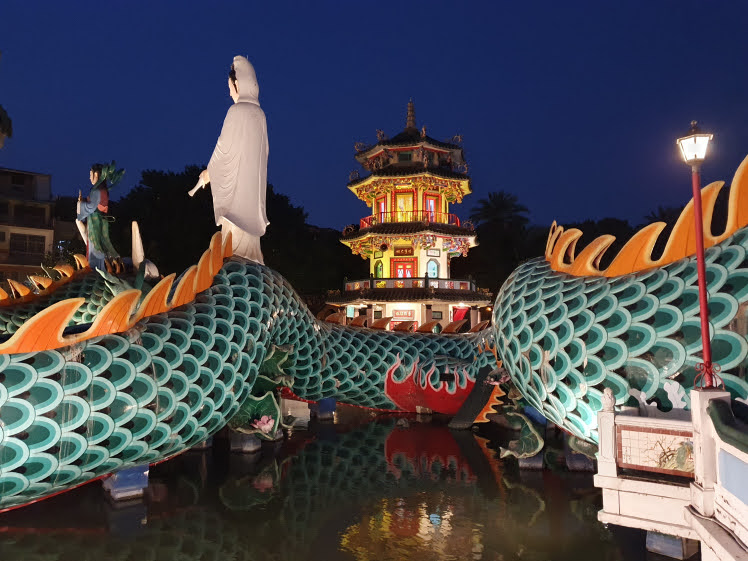
The next temple we visited was the Spring and Autumn Pavilions that also extend out onto the pond. The pavilions are four stories high and octagonal in shape.

  With green tiles and yellow walls, the pavilion looks like antique pagoda.

The two pavilions are connected by a curve bridge with a statue of Quanyin, the Goddess of Mercy, riding a dragon in front of the Spring and Autumn Pavilions.

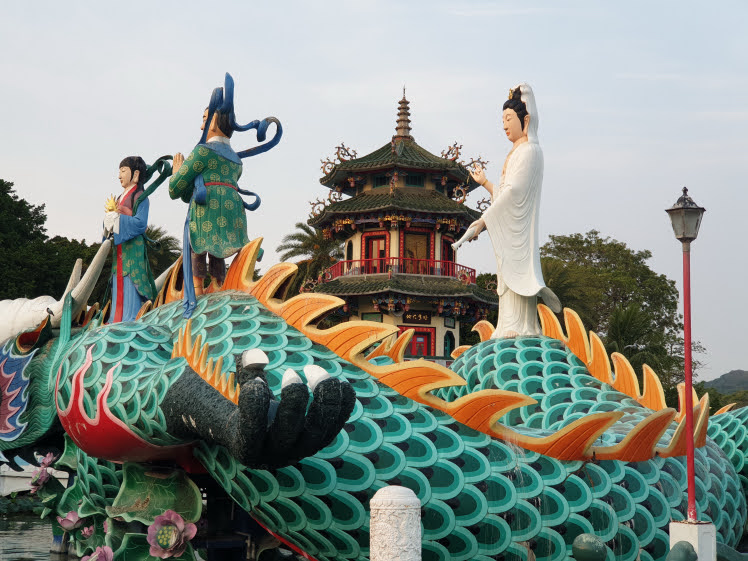
Quanyin, the Goddess of Mercy

Quanyin, the Goddess of Mercy, riding a dragon

The colourful dragon is very striking but the entrance was shuttered so we could not walk through its mouth and exit from the back to the pagodas.

Nevertheless, we could still access the pavilions from the sides. 
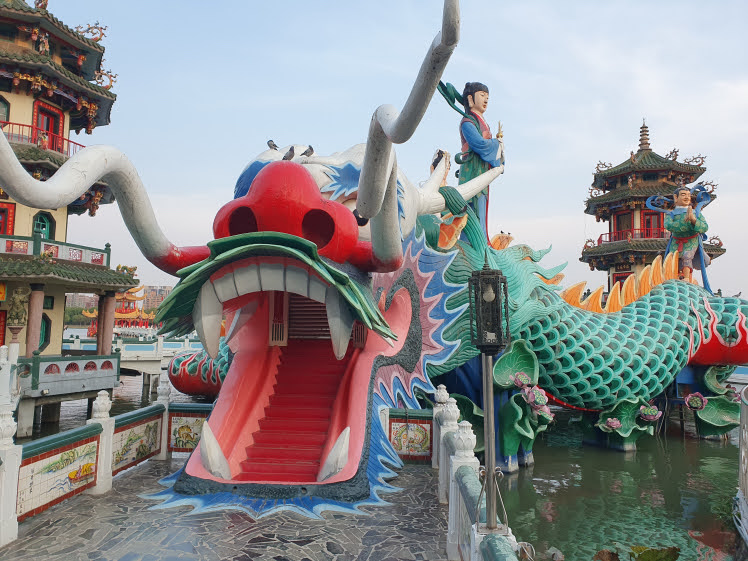
This is a good place for photographers with its vibrant colours.

The only lotus we saw on the Lotus Pond. Not at their best. 

There is a 2 storey pagoda called the Five Mile Pavilion (五里亭) connected by a long pier at the back of the Spring and Summer Pavilion.  

Cute little ducks hunting for food in the Lotus Pond.

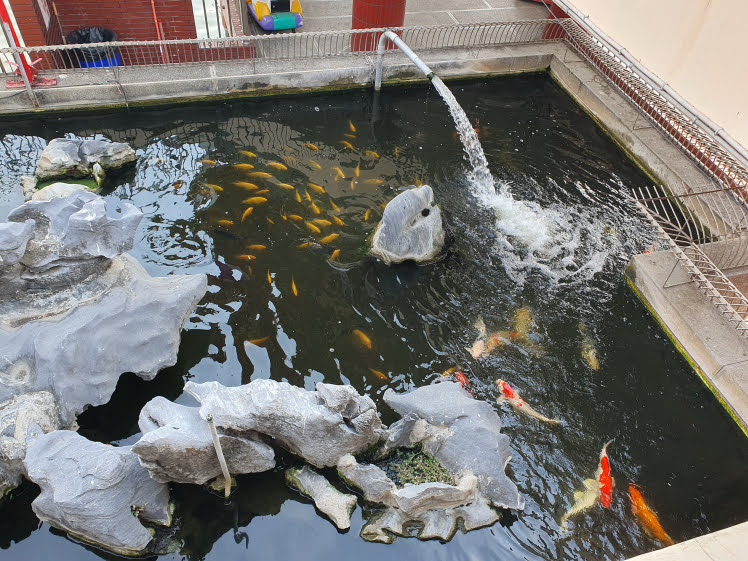
There is a half moon shaped pond with lots of tortoise in the front of the Guanyin, the Goddess of Mercy.

Temple of Enlightenment

Standing right across the road from the Spring and Autumn Pavilion is the Temple of Enlightenment or Chi Ming Tang temple. It is the largest temple in the area and looked quite impressive.

Buskers performing in front of the temple.

We made the mistake of not going inside this temple for a look as we were too fixated by the Spring and Summer Pavilions.

Dragon and Tiger Pagodas

On the southern edge of Lotus Pond are the red-and-yellow seven-storey Dragon and Tiger Pagodas. Actually this was the main highlight of Lotus Pond Scenic Area for many years. It was unfortunately undergoing renovations and temporarily closed till further notice.

Dragon & Tiger Pagodas covered with scaffoldings, as viewed from the Spring and Summer Pavilions.

A zigzag bridge provides access to the pagodas with giant statues of a dragon and tiger at the front.

We did not visit this place. If you visit this place when it is re-opened, be sure to enter through the dragon's mouth and exit through the tiger's jaws. To do otherwise would bring bad luck.


Sunset and Night Views at Lotus Pond

We lingered at the Spring and Autumn Pavilions till sunset. A good place to watch the sunset is at the upper deck of the Five Mile Pavilion. 

Pagoda at the Spring Summer Pavilions from where we watched the sunset.

  Sun setting behind the Temple of Enlightenment.


Zoom in shot of the sun setting behind one of the tower.

View from the upper deck of the pagoda.

We waited for the lights to come on after the sunset. At night the temples are illuminated, creating multi-coloured reflections in the water.

Spring and Autumn Pavilions.

These are the photos we took as we started our walk from the Spring and Summer Pagodas back to the Zuoying Yuandi Temple.


The lights on the link bridge would change its colours from time to time, varying from red to blue to purple.

Zuoying Yuandi Temple at night.

After visiting Lotus Pond, we took a taxi to one of Kaohsiung’s very popular night markets, the Ruifeng Night Market for dinner. There are several night markets in Kaohsiung. This is the closest and it is also within walking distance to our hotel.

Continue Reading »

Ruifeng Night Market (瑞豐夜市) in Kaohsiung

30 March 2024

After spending an afternoon at the Lotus Pond where we stayed till sunset, we took a taxi to Ruifeng Night Market (aka Rueifong Night Market). Although there are several night markets in Kaohsiung, this night market is located next to the Kaohsiung Arena MRT station in Zuoying district, very close to the Lotus Pond Scenic Area. It is also currently the largest and most crowded night market in Kaohsiung.

Our taxi ride was less than 10 minutes. After alighting from our taxi, we joined the hordes of people waiting to cross the road at the traffic junction. We could see that the market is very popular with the locals.

Like most typical Taiwanese night markets, we could find every kind of traditional street food such as fried squid, octopus balls, grilled wild boar sausages, noodles, papaya milk, milk tea, and chicken and beef steak, as well as arcade games, clothes, and other shopping.

Entering the market, we were shoulder to shoulder with lots of hungry people enjoying their weekend night out. It was too crowded for my liking. Ruifeng Night Market has many streets with rows of food stalls on both sides. We moved to an area of the market that is less crowded before hunting down some food for dinner.  

Less crowded part of the night market. 

We could not resist the delicious looking grilled beef cubes and it was our first food item in the night market.   

The beef is cooked to order. There are various sauces or seasoning available, including chilli powder, ground black pepper sauce, rose salt, cumin powder, onions, italian seasoning and teriyaki sauce.

Our first food item for the night. Grilled beef cubes. 

Nice finishing touch with a blow torch.

Yummy grilled beef cubes with salt and black pepper.

We also bought some deep fried cuttlefish seasoned with salt and batter from another nearby stall.

Another popular street food to try is the deep fried sweet potato balls. They are best eaten right away while still warm. They are chewy in texture with a sweet sugary crust. Yummy!

QQ Sweet potatos balls.

Most of the food sold are for takeaway in this part of the night market.

Beside food, the Ruifeng Night Market also have stalls providing arcade and amusement park style games that test your skills or your luck. 

We went to a side alley with game stalls to watch local kids and young people try their skills or luck while eating our food. I noticed most of the patrons are locals.

Game of chance and also game of skills


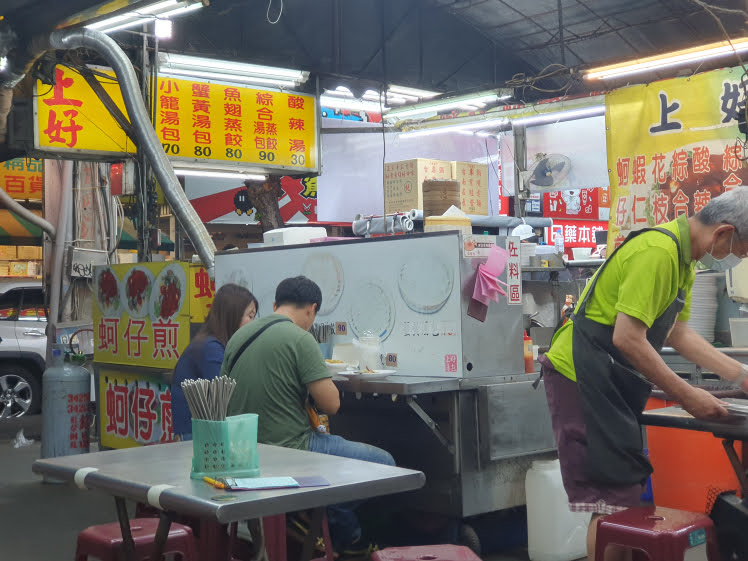
One of the street food I really wanted to try was the Taiwanese oyster omelette. Oysters are abundant on this island. We found a stall that provided tables and chairs for a sit down meal.

The oyster omelette dish originates from Fujian and spread across the rest of Asia with each country crafting up its own version of the dish. I had tried several versions of this dish within South East Asia.

Sarawak’s version of oyster omellete with thin crispy batter.

Singapore’s version has eggs, sweet potato flour mixed with water and green spring onions. It is stir fried on a very hot metal hotplate or wok with lots of oil, broken into bite-sized bits, to create crispy edges on the batter. Salt or fish sauce is added to give the dish a salty, umami loaded taste. The Singapore oyster omelette is eaten with a spicy and sour chilli dipping sauce to balance out the greasiness.

The pale looking and “less fried” Taiwanese version came in a whole price like a pancake, with no crispy bits. It came with sauce on top that is slightly sweet. It is more bland and is not a bad dish if you don’t compare.

But I definitely prefer the Singapore version although it is probably the less healthy version.

Taiwanese oyster omelette came in a whole piece with a sweet sauce on top.

Digging into the dish, I could see chopped onions and tiny oysters.

We also ordered the Xiaolongbao from this stall. This is a type of small Chinese steamed bun (baozi) traditionally prepared in a xiaolong, a small bamboo steaming basket. The buns taste the same as the versions in Singapore. It is best eaten with a black vinegar dipping sauce topped with strips of fresh ginger.

Steamed buns served in the small steaming basket.

We ended our food adventure in the night market with a hot and cold desserts. We order a red bean soup with soya bean curd or douhua. Douhua is made from coagulated soybean milk. It looks, feels and tastes like extremely tender tofu.

Warm red bean soup with douhua (left) and green bean soup with crushed ice (right).

Continue Reading »

Welcome to igoiseeishoot!

Thanks for visiting the igoiseeishoot blog. If you are visiting for the first time, you may want to start here.

This blog is where I share the places I have been to (I go), my experiences at these places, people I met, food I tried and things that fascinated me (I see) and memories of my travels and vacations with lots of photos (I shoot).

I hope you will enjoy reading the posts or find something useful in this blog.

I would love to hear your thoughts or feedback by email (igoiseeishoot@gmail.com) or dropping some lines into the comment boxes of the posts.

Stay connected with me on instagram.