26 August 2023

Shiretoko National Park covers most of the Shiretoko Peninsula at the north-eastern tip of Hokkaido. It is one of Japan's most beautiful and unspoiled national parks. The peninsula is home to Japan’s largest population of brown bears, as well as ezo deer and red foxes.
No roads lead further than about three fourths up the peninsula, and the northern tip can only be viewed from boats.
The main highlight for us would be doing a hike at Shiretoko Five Lakes or Goko. These five small lakes were formed long ago by the eruption of nearby Mount Io and fed by underground springs. A 3.6 km long hiking trail offers beautiful views of the five lakes, wilderness with surrounding mountains in the background and provide visitors an easy way to experience Shiretoko's unspoiled nature.
This trail is opened from mid-April to mid-November but often closed due to the presence of dangerous brown bears which roam freely in the park. During the “bear active season” where there is a peak of bear activity from May 10 to July 31, access to the nature trails is possible only by joining a tour group led by a licensed, Japanese speaking nature guide. Tours take about three hours and depart every ten minutes. They cost around 5000 yen per person.
There is also a 800 meter long, wooden elevated boardwalk leads from the parking lot to the first lake. The boardwalk is free to use, wheelchair accessible and open for the entire season from late April to late November. However, visitors can only see views of the First Lake, the Sea of Okhotsk and the surrounding mountains.
We were lucky to visit during the Eco Preservation Awareness Season (which starts from 1 August) where the nature trails can be walked on an individual basis without guides. However, we need to a pay an admission fee of 250 yen per person and attend a 10 minutes lecture with video presentation to get "certified" for the ground hike. A maximum of (50) visitors are admitted at a time with (10) minute intervals.
It is also important to check the status of the trail before going as the trails may get closed in case of bear sightings.
In our case, we went early on 26 August 2023. The trail was actually closed the day before (on 25 August) due to brown bear sighting!
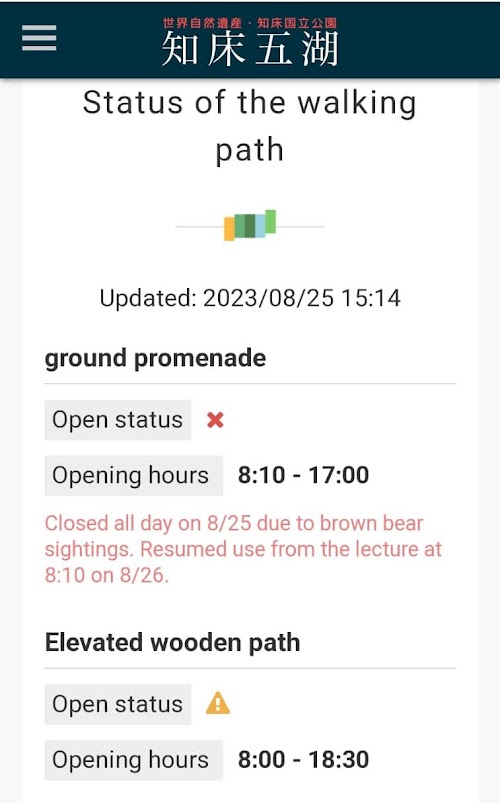 We were fortunate to visit on Aug 26 when the trail reopened.
We drove to the Shiretoko Goko Lakes Field House early in the morning. First, we must complete a form with our personal particulars. Then we purchased the admission tickets from a vending machine in the Shiretoko Goko Lakes Field House. Once done, we presented the tickets and completed form to the attending rangers to register for the next ground trail lecture at 8.40 AM.
It is advisable to do the ground trail hike early in the day for two reasons:
1. The trail would be closed for the day once a bear is spotted. So, go early before anyone spots a bear that day!
2. The forest will be cooler in the morning.
The lecture was presented in Japanese but there is an accompanying video with English subtitles so it was easy to follow. The video is about the “dos and don'ts” when in the park and how to avoid encounters with bears. Brown bears could attack if they are surprised or if they need to protect their cubs. Humans cannot outrun a bear, so the best way is to announced our presence and they will typically avoid contact. We were told to clap our hands and shout out loud if walking through closed terrain with poor visibility ahead.
Once the lecture was completed, the group of about 50 persons were let loose into the ground pathways.
 Short and long duration routes are available along the Ground Pathways. Almost everyone chose to do the long route that goes through all 5 lakes.

Starting our hike on the ground trail.
Besides being fortunate to come on a day when the ground trail was open, we were also blessed with excellent weather. The sky was clear and blue with scattered clouds, giving us excellent views of the lakes and Shiretoko mountains. However, it was also humid and warm in the forest. We were soon perspiring from the hike.
Initially after starting the trail, we were part of a large group. There was little chance of us encountering any bear as the family in front of us with two small kids were making so much noise (clapping, singing and shouting) that any bear would be long gone.
The group later dispersed as each family or groups walks at different pace. Some, like us, linger to snap photos at each scenic spot. And there were plenty of scenic spots!
These are the photos we took during the hike on the ground trail.

The first lake we saw was the Fifth Lake.
 Shiretoko's unspoiled nature.
 Fifth Lake.
 Pink mushrooms growing on side of the boardwalk.

The Fourth Lake with the Shiretoko mountains reflected on the surface of the lake.

Awesome scenery!

More mushrooms.

More views of the Fourth Lake and mountains.


Imagine meeting a brown bear that may appear anytime.

Third Lake.


Views of the Second Lake.


There are actually 2 viewing points for the Second Lake.

At the second viewing point of the Second Lake.
 Tree trunks snapped like matchsticks from the force of previous storms or typhoons that is common in Japan.

The views get better and better!

Second Lake.

Arriving at the First Lake.

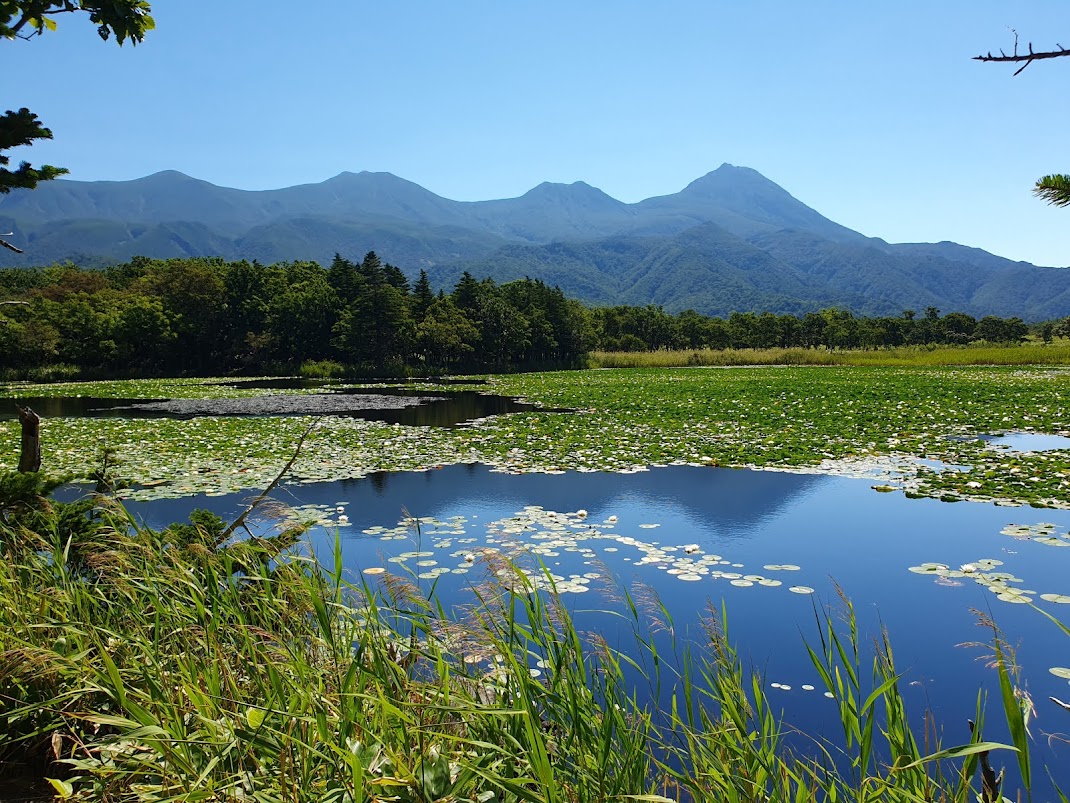
Water lilies cover a large part of the First Lake.
 View of the elevation platform from the ground trail.
The last part (800 m) of the 3 km long loop was on the elevated wooden platform. The wooden platform zigzags through an almost flat, bushy terrain with views of the Shiretoko Mountains on one side and the Sea of Okhotsk on the other side and clear blue sky above.
We stopped to take the “mandatory” photo at the Lakeside observation deck with views of the First Lake and the Shiretoko Mountains in the back.

Photo spot on the Elevated Platform with the First Lake and Shiretoko Mountains in the background.
The elevated pathway offers a safe viewing platform due to the installation of an electric fence on the side. The signage on the electric fence gave me feeling of Jurassic Park as I walked down the path, half expecting a bear to jump out from below. Unfortunately, no animal was sighted. Not even a deer.
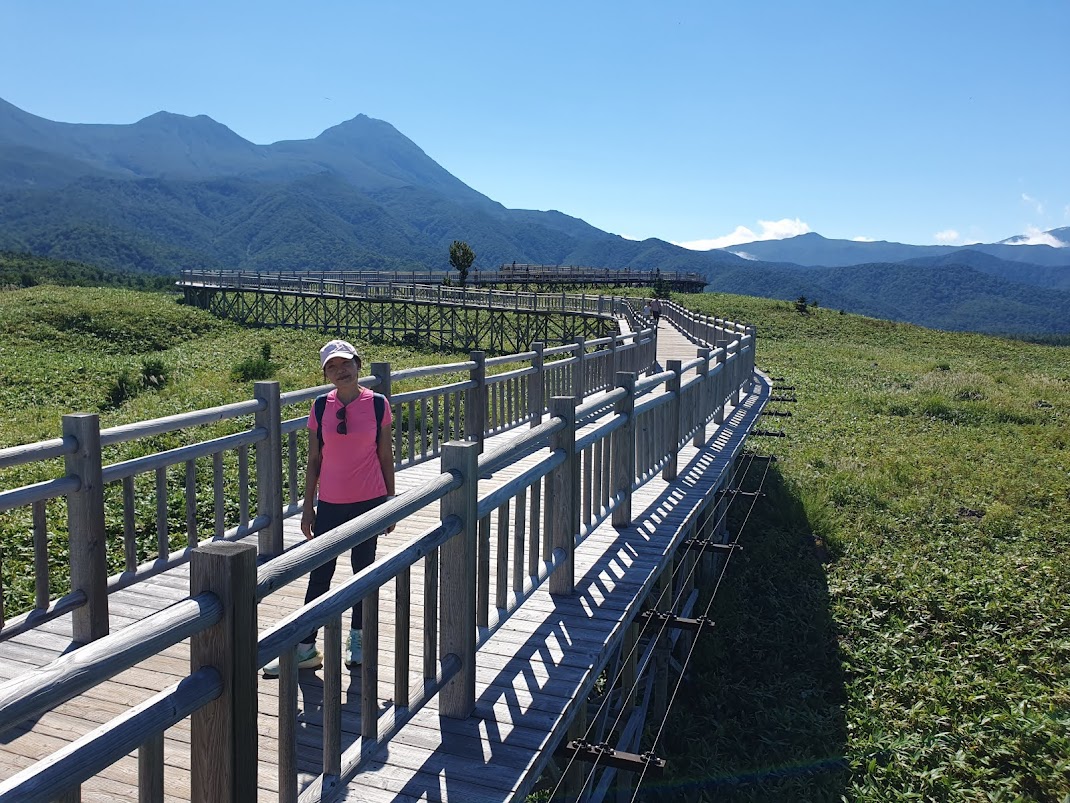
Bears are excellent climbers. The electric fence could be clearly seen on the side of the elevated pathway.
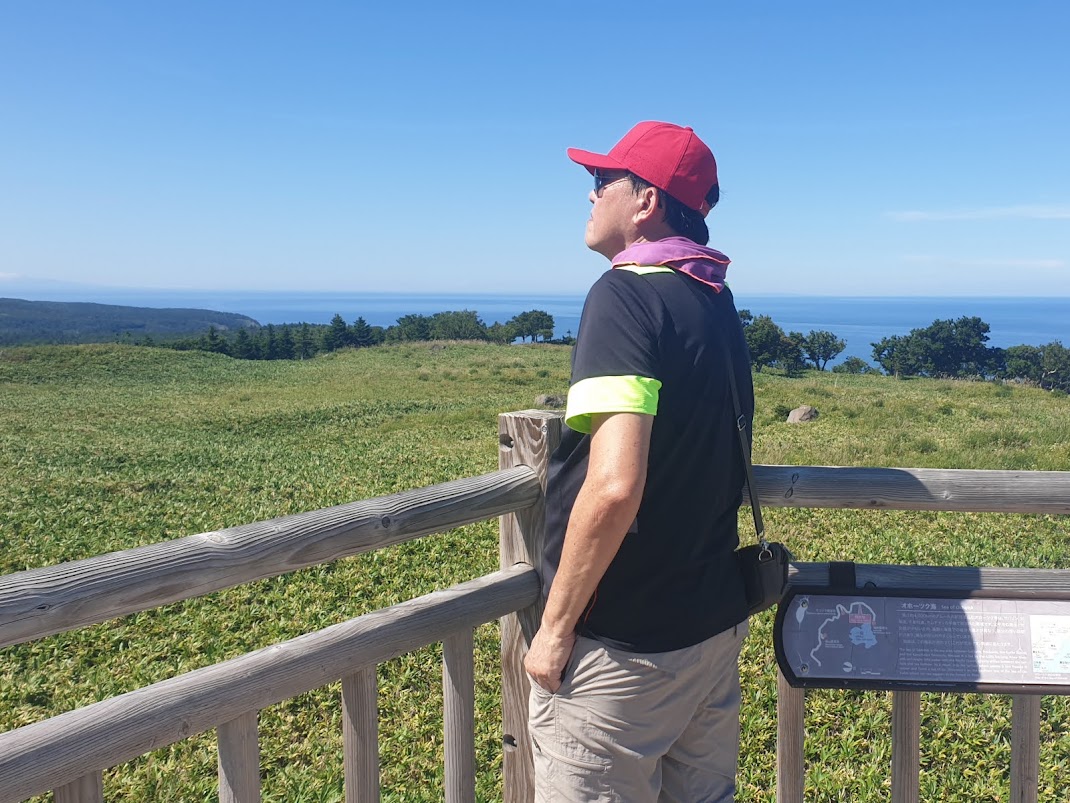 View of the Sea of Okhotsk.
 Visitors using all means to protect themselves from the scorching sun.
The walk back to the Field House was an anti-climax. By then, it was just too hot to the enjoy the walk on the elevated platform. Overall, our walk on the trail took about 2 hours.
My original plan was to drive on an unpaved road to see the Kamuiwakka Hot Falls after the Five Lakes hike. This waterfall is unique in that it is fed by a natural hot spring, so the water is warm.
We skipped going to the Kamuiwakka Hot Falls as they did not allow visitors to self drive to the falls during this period. Instead, they were charging 2000 yen per person to go via shuttle bus.
After a short rest at the Shiretoko Goko Lakes Field House, we continued on our drive to Rausu via the Shiretoko Pass.