Links to My Vacation Journals and Destinations

Looking for something in this blog?

Hiking Mount Meakan and exploring Akanko Onsen

28 August 2023

After exploring Lake Kussharo and Lake Mashu in the northern part of Akan Mashu National Park, the plan for the day is to drive south and explore the attractions around Lake Akan (Akan-ko).

Lake Akan is a caldera lake formed by the collapse of a volcano long time ago. It lies between Mount Oakan and Mount Meakan at an altitude of 420 meters above sea level. Located southwest of Lake Akan, Me-akan literally means "female Akan", as opposed to Mount O-akan, the "male Akan", which rises east of the lake.

Akanko Onsen is the only hot spring resort town located on the southern shore of Lake Akan. It is a small town with onsen hotels, shops, eateries, free public footbaths and Ainu Kotan, a small replica Ainu village.

Map showing the locations of Lake Akan, Akanko Onsen, Mount Meakan and Mount Oakan.

This was the day that my son and I were looking forward to. A tough hike to the summit of Mount Meakan, an active volcano in the Akan Mashu National Park, that offers breathtaking views not only of the mountain's deep main crater, but also of another, much flatter crater to the north and of the beautiful cone-shaped peak of Akanfuji nearby. My wife, who was not keen to join us, will explore Akanko Onsen while we are up in the mountain.

Hiking Mount Meakan is usually possible from May to early October via three routes. We chose to do the shortest and possibly steepest route starting and ending at Meakan Onsen. The trail is 3.3 km one way to the summit, with elevation gain of 789 m. It should take around 4 to 5 hours for the hike to the summit and back.

It was good that we had a good and filling Japanese breakfast at Hotel Parkway in the morning. Hotel Parkway is located in Kawayu Onsen and it took about an hour’s drive to get to Lake Akan.

Our Japanese breakfast at Hotel Parkway that will provide energy for our strenuous hike on this day.

We stopped at a Seicomart in Teshikaya to buy rations for our hike (bananas, energy drinks and Onigiri) and a few cans of strong zero beer to drink at the hotel in the evening.

We alighted my wife at the Akankohan Eco Museum before proceeding to the Meakan trailhead. We planned to pick her up, somewhere in Akanko Onsen, after our hike.

Mount Meakan hike

From Akanko Onsen, it was a 20 minutes drive to the trailhead. We parked our car at a public car park near Meakan Onsen, ate the bananas in the car and got ready for the hike. There are no toilets along the trail, so it was wise to use the clean and well maintained public toilet next to the car park.

We walked back to the trailhead (google map location here) which is a few hundred meters from the car park. There are signage and a small wooden box where hikers could register their personal particulars and contact number of next of kin in case of emergency. After all, Mount Meakan is still an active volcano.
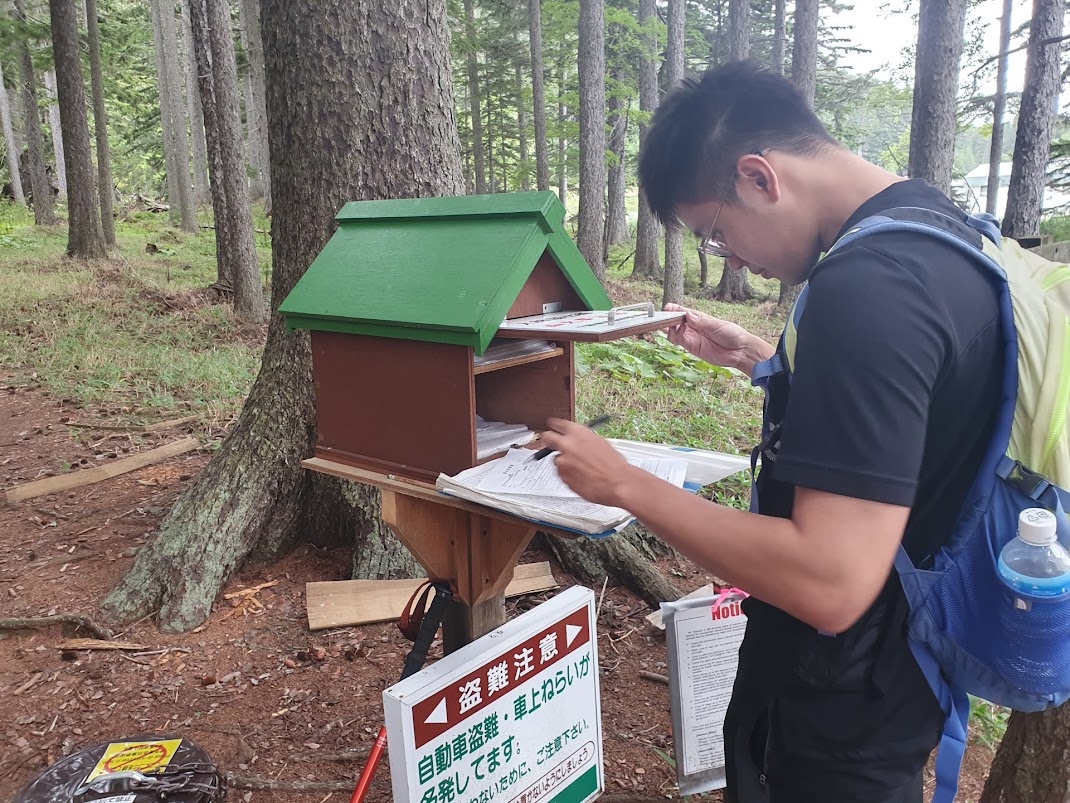
At the trailhead, we registered our particulars on a form in the little wooden box.

It was 9.30 AM when we started the hike. After being blessed with excellent clear blue sky weather on our hikes in Shiretoko National Park, the weather started to turn on us. Although the sky was cloudy with rain forecasted for the afternoon, there was no rain and the forest was quite cool and pleasant.

My son, who is half my age and twice as fit, volunteered to carry the backpack with our drinks, rations, powerbank and jackets. As an avid hiker who had conquered Mount Kinabalu and Mount Rinjani earlier this year, hiking Mount Meakan would be easy for him. For me, it would be a physical challenge but I think willpower make my old body go.

The first part of the hike was though a forested area of pine trees. The forest was quiet. We seemed to be the only hikers around. There is danger of encountering brown bears in such situation. We clapped our hands and made noises when we passed thick bushes or shrubs. We also had a small bear bell that we purchased a few days ago, attached to our backpack. So a-ding-a-ling, we went through the forest.

The exposed tree roots is reminiscent of my hike along the Kumano Kodo trail 7 years ago.

There are red ribbons tied to trees, marking the trail in the forest. It was a pleasant walk as the ascent at this stage is not so steep.

A photo to send to my wife to inform her that we had started the hike.

Some wild mushrooms that we spotted.

The forest of large pines eventually thin out into open rocky ground and dwarf pines about 40 minutes into the hike.

The ascent got a little more steep after we left the forested area.

As we got higher, we could feel and see the clouds moving in.

We met a hiker who was on his down and he was kind to tell us about the foggy conditions at the peak. Nevertheless we decided to press on as the journey was part of the fun.

Visibility was getting bad as the wind blew the clouds across the mountain.

Another progress photo that we sent to my wife who was having a good time on her own in Akanko Onsen.

The trail to the summit is divided into 10 stages or stations. There are route markers informing hikers of their progress.
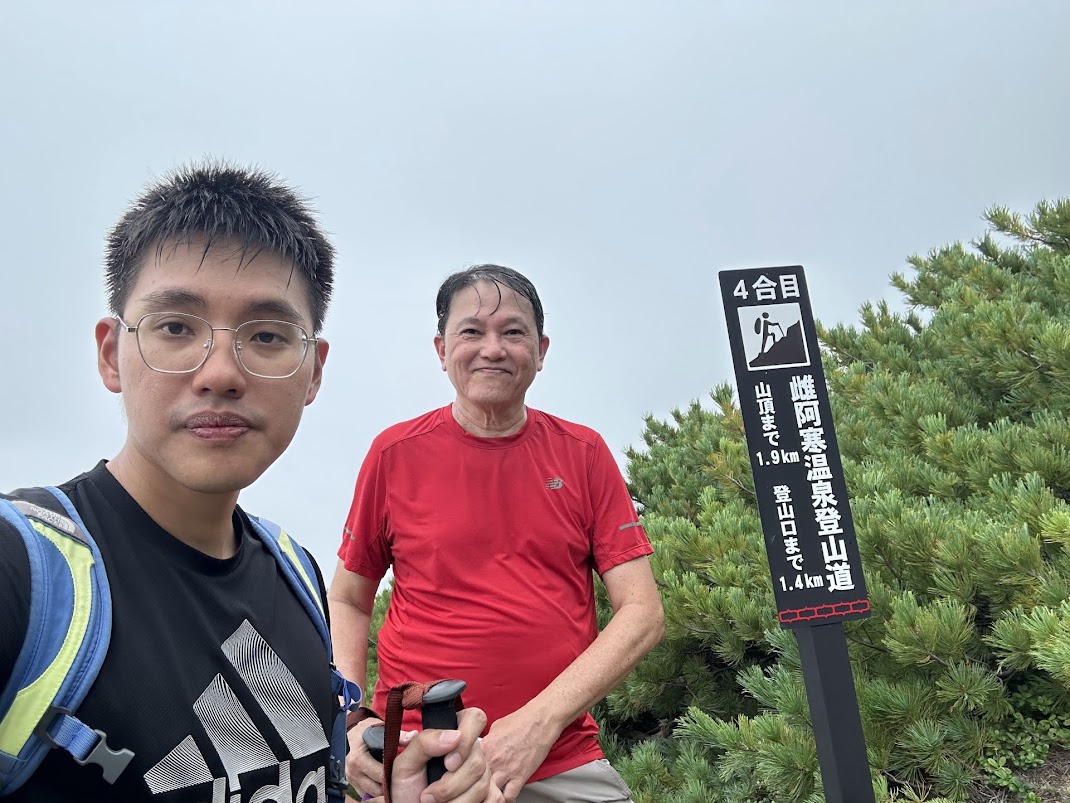
At the 4th station. We had covered 1.4 km. Another 1.9 km to reach the summit.

Somewhere near the 4th station, we spotted a unique looking imprint on the ground that looked like the paw print of a bear! It was the only imprint on the ground, so I thought it may be a prank and not a bear track.

Is this the paw print of a brown bear?

In any case, I was not too worried as the print looked aged (probably made when the soil was wet and now the soil was kind of dry). The creature that made the print should be long gone by now.

We were soon scrambling over large boulders with pine shrubs next to us. The pine shrubs disappeared as we approached the crater. It is volcanic terrain from this point onwards.

The trail is marked by yellow paint on the boulders as we zigzaged our way up. We heard faint sounds of tingling bell in the fog up ahead and soon met another 2 hikers on their way down. They were fully suited up. We realised that we should put on our hiking jackets even though we were perspiring. It is important to prevent the body from losing too much heat in the cold wind.

We arrived at the 7th station at 11.23 AM, almost 2 hours after we started. Only 900 meters to go.

From the 7th station onwards, the terrain was extremely steep (from my point of view) and more challenging. There were pebbles and large rocks.

We were overtaken by a man, who was going at twice my speed. I think my son would be able to keep up with him, but he has to stay by my side.

I thought I could see the summit but every time I got to the “summit”, there was another one. The curvature of the terrain could fool you there.

Eventually, we could hear the roar and hiss of the vents from the crater and I knew we were close to the rim. The trail flattens out as we arrived at the rim.
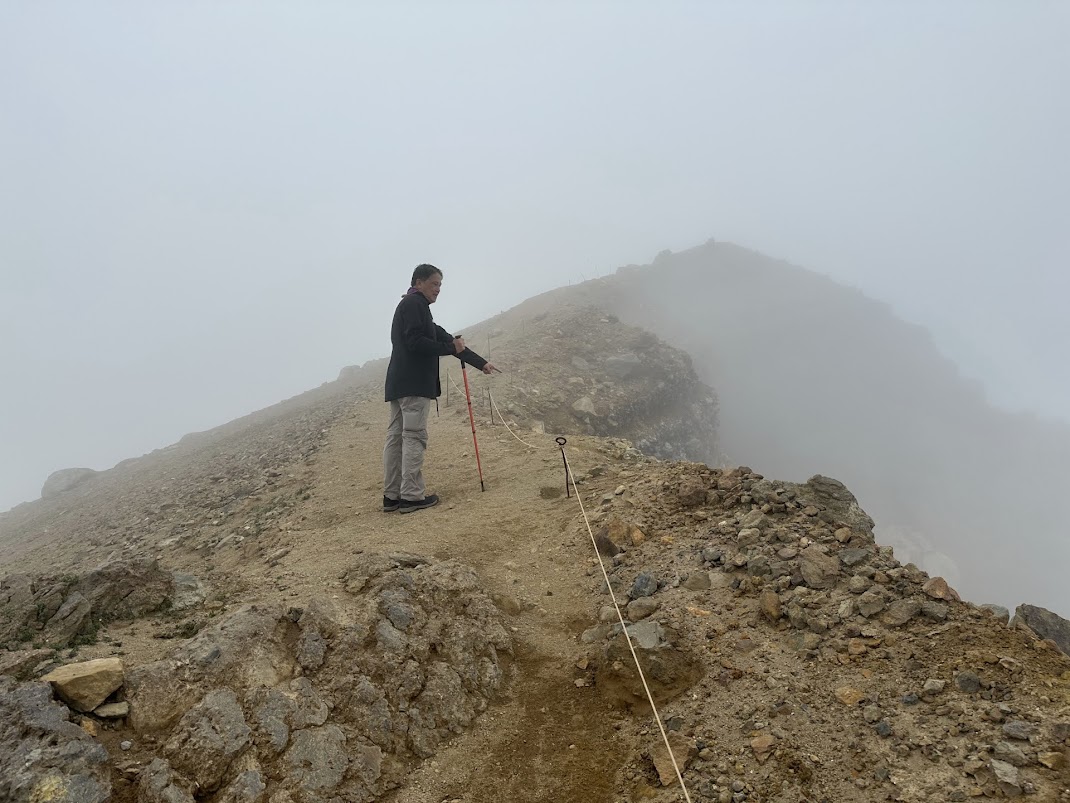
Hiking along the crater rim of Meakan.

There are guide ropes to prevent accidents. It was foggy and we could not see any of the views of the mountain's deep main crater.

We just followed the guide rope to the summit at 1499 meters above sea level. We arrived at the summit at 12.15 AM, meaning it took us 2 hours 45 minutes.

A simple marker was at the summit.
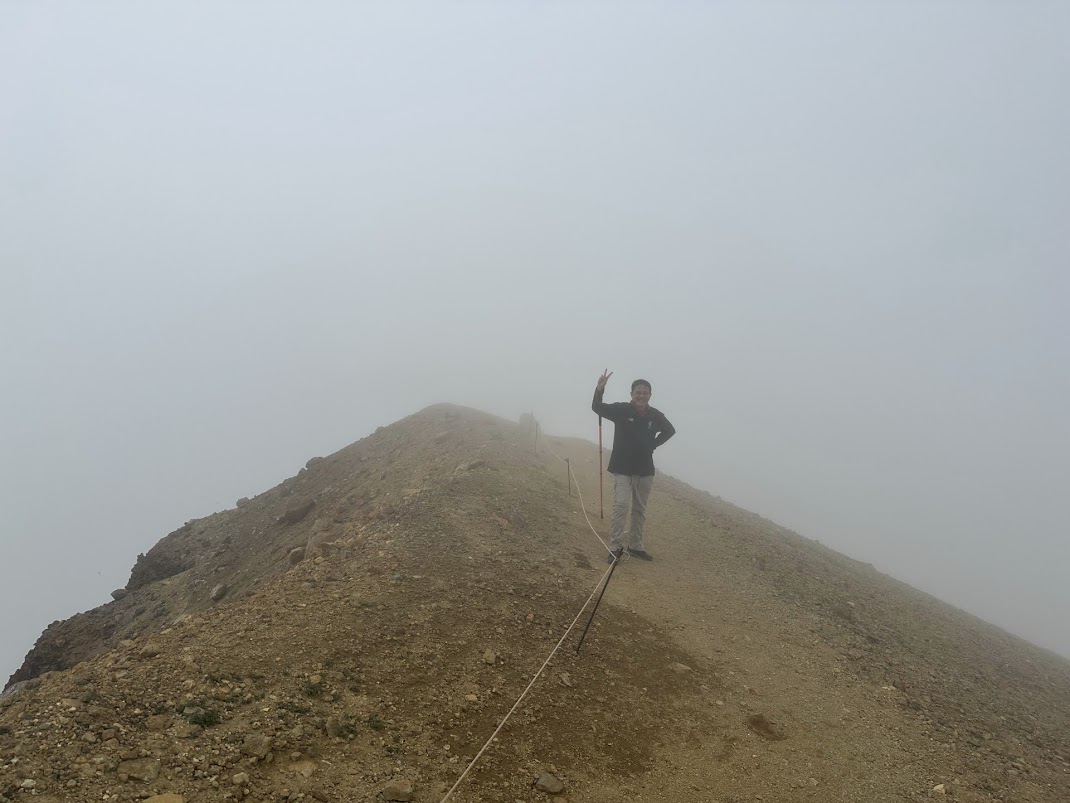
Almost at the summit.

The hike is easy for him.

A photo to mark our achievement. The Kanji words basically stated that this is the summit of Mount Meakan.

We did not linger too long at the summit as the fog is not going to lift anytime soon. We knew we would not see the amazing sights due to the poor weather but overall I am proud and happy to have met the physical challenge. For my son, this hike is part of his preparation to do the hike to Everest Base Camp in November.

On our way down, we stopped at the 7th station, sat behind a large rock that shielded us from the wind and took our lunch. Somehow, food tasted good when eaten outdoors. In my case, I needed this energy to fuel my body for the journey down. By now, I was running on empty.
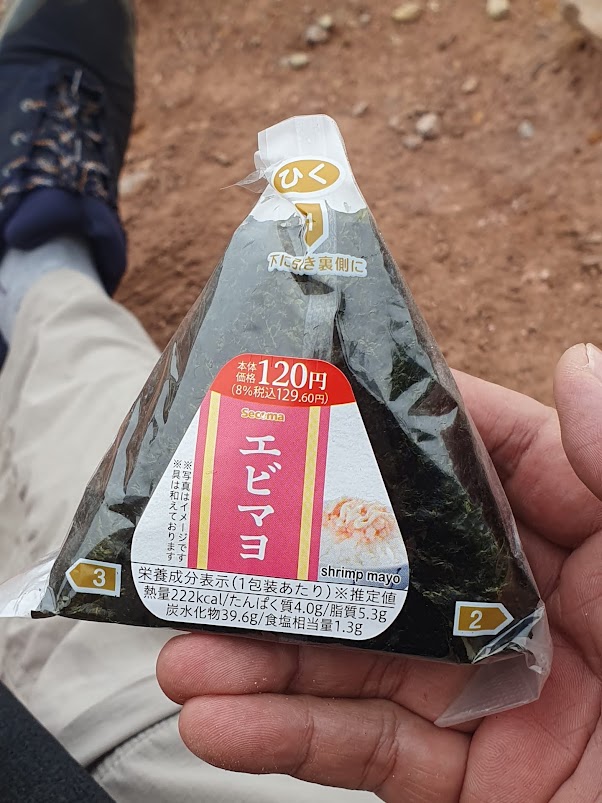
Our lunch – drinks and shrimp mayo onigiri.     

This was the only time we both sat down and rested.  

After our quick lunch, we made our way down the same path. Our pace on the way down was slightly faster. It was easier on the lungs but not my aged knees and legs. I did not dare to sit down and rest as I knew my legs would turned into jelly once I stopped walking. 

We arrived back at trailhead at Meakan Onsen at 2.38 PM. Overall, the hike had taken slightly over 5 hours.

Exploring Akanko Onsen

While we are hiking Mount Meakan, my wife explored Akanko Onsen on her own.

The Akankohan Eco Museum, which opens at 9.00 AM, is a good place to start as most shops and eateries in the town do not open until later in the day. There are exhibits about the surrounding natural sights such as Akan’s scalable volcanoes (Mount Oakan and Mount Meakan) and lakes (Lake Akan and Lake Onneto).

One of the unique exhibits not to miss is Lake Akan's famous marimo. These are rare lake algae that grow into fluffy green balls of varying sizes. It is believed that the spherical shape is formed by the aggregation of filamentous alga and the rotary motion due to water turbulence. These are slow growing. Left alone for a few centuries, Lake Akan's marimo can reach the size of soccer balls.

Aquarium exhibit in Akankohan Eco Museum showing the marimo, found in Lake Akan.

After visiting the museum, there is a short (15 minutes) walking trail that leads through a pine forest to bubbling, geothermal mud pools, known as bokke located next to Lake Akan. From there, the trail continues along the lake shore back to town.

Like most places of nature in Hokkaido, there are chances of encountering the wild animals such as deer, red foxes or even the dreaded brown bears.
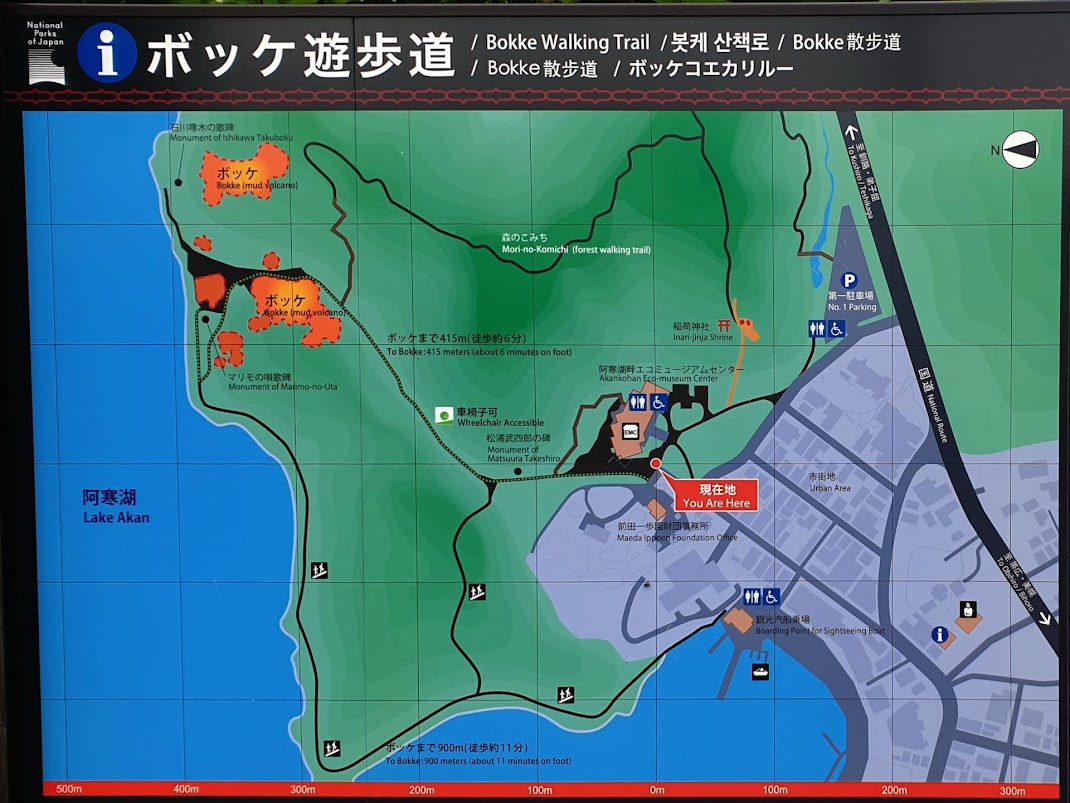
Map of the walking trail and bokke.

Being cautious by nature, my wife would not take the trail through the forest on her own. There was another group on that trail, so she went along.

Well signposted forest trail from the Eco Museum to the bokke.

Some travelling companions on the same trail

They met a family of wild Ezo deer along the way.
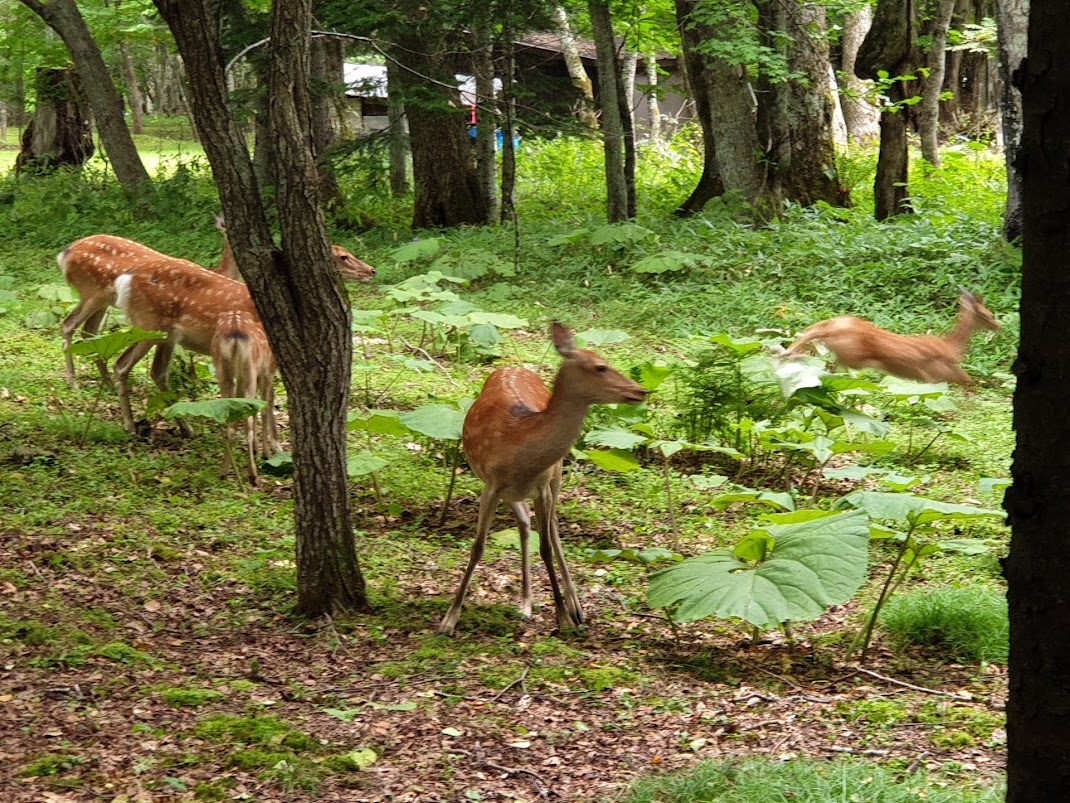
Lucky to meet this group of wild deer up close. She almost turned back because of them.

After the deer went away, she continued her walk to the Bokke. Here, volcanic gases could be seen bubbling up through the mud from the magma below. The temperature of the mud pool is close to 100 degrees Celsius which is the temperature of boiling water. This is a reminder that Lake Akan is a caldera lake with volcanic activity underground.

One of the mud pools.

The trail continues along the shore of Lake Akan to the cruise boat dock where tourists could buy tickets for a cruise on Lake Akan.

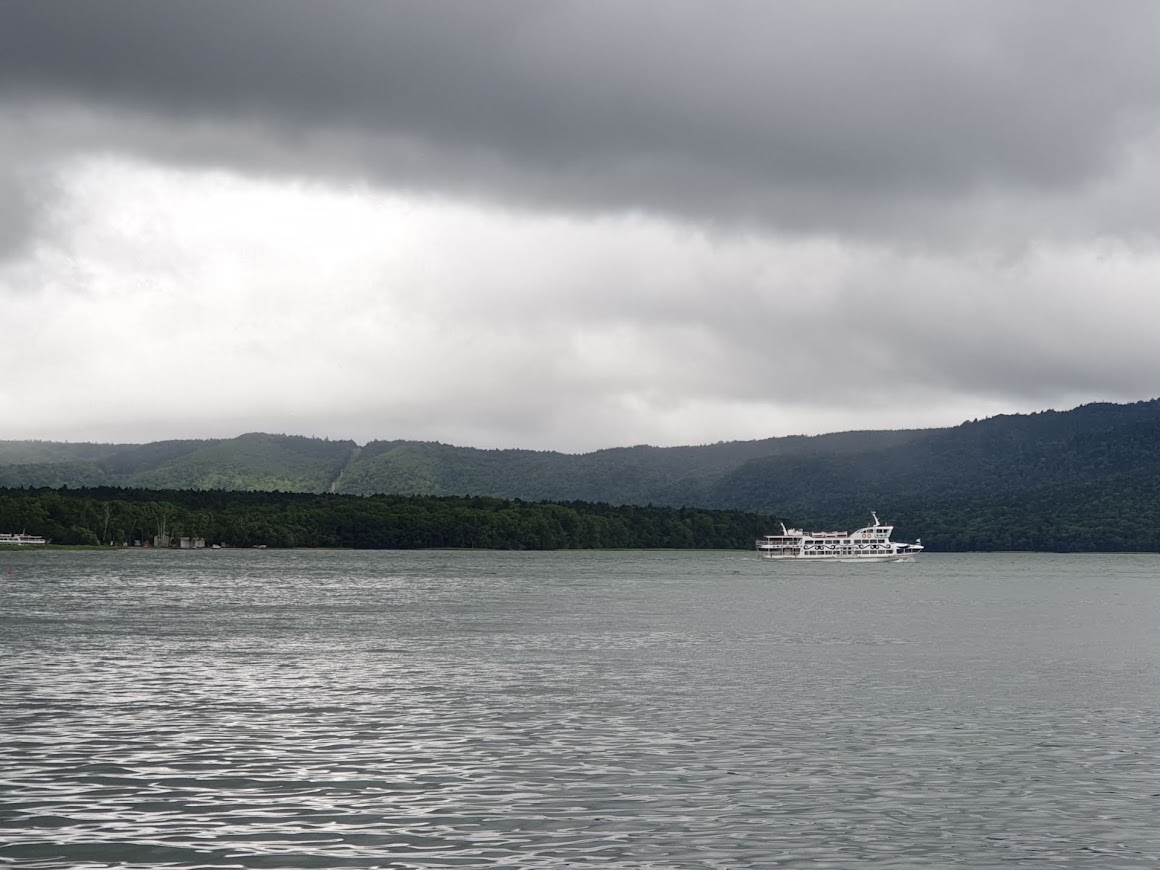
View from the shore of Lake Akan. It is quite a big lake, with circumference of 26 km.

Cruise boat on Lake Akan. Note the dark clouds over the area.

Summer flowers seen along the walk.   

There are several hot spring hotels located near the cruise boat pier.

A good place to rest after the walk is at the Pan de Pan. This is a bakery that sells mostly takeaways but has a eat-in restaurant with approximately 20 seats with red theme decor. There is a free footbath corner in front of the store.

Tea break at bakery called Pan de Pan – coffee and cream filled choux pastry.

Ainu Kotan is the next place to explore. "Kotan" means "village" or "settlement" in the Ainu language. The Ainu are the indigenous people in Hokkaido. This is a small Ainu replica village in Akanko Onsen, which consists mainly of one street lined by souvenir shops specializing in Ainu handicrafts. These include wood carvings of bears, birds, humans, and Ainu art.

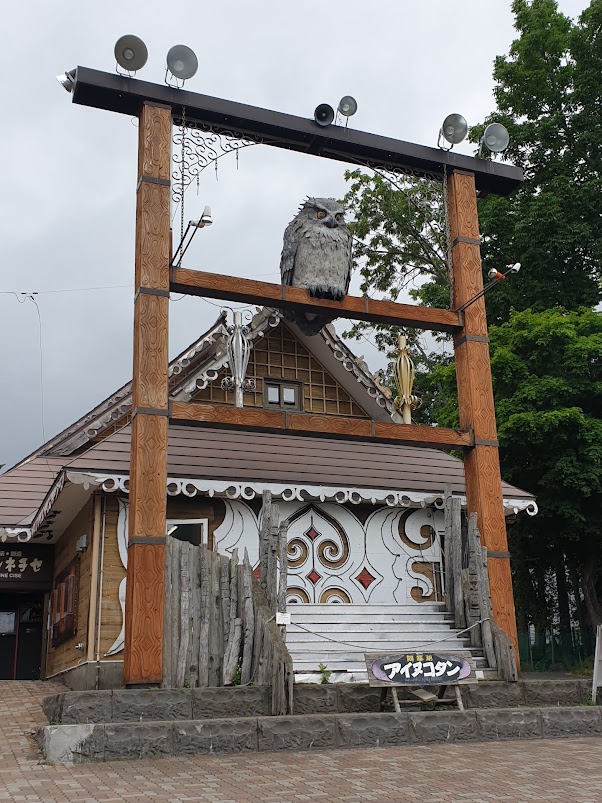
Entrance to Ainu Kotan. The owl at the gate is the Blakiston’s fish owl, considered to be a protector of the Ainu Kotan village.

Mostly souvenir shops selling Ainu theme handicrafts.

Another owl symbol in the Ainu Kotan village.

There are also a museum about Ainu art and tradition and a theater where various traditional Ainu performances are staged. The Ainu Living Memorial Hall recreates a traditional home for an old-fashioned 4-5 person family.

Inside this "Pon cise" (small house), displays of daily items and clothing tell of life in times gone by.

While the men were eating a picnic lunch of onigiri and energy drinks on top of a foggy windswept mountain, my wife enjoyed a nice warm meal at Ajishin. Ajishin restaurant specializes in Hokkaido deer meat.

One of the must-try menu items is the rice-bowl topped with slices of grilled deer meat dressed with a salty-sweet soy sauce.

She missed out on the deer meat rice set at Kawayu Onsen and now has a chance to enjoy the deer meat rice bowl at Akanko Onsen.

After lunch, the next best thing to do was to have a nice drink and soak her feet at one of the free public footbaths while waiting for the men to finish their hike. 

Enjoying a warm footbath at Lake Akan Marimo Footbath “Ure Karip” located opposite Bar de Pan.

Akanko Onsen is considered to be the origin of hand baths that are now popular across Japan. The handbath in front of Kanko-do Crafts Shop is called "Owl Hand Bath" which is made from a hollow trunk of an elm thousands of years old. Above the bath is a wooden sculpture of a Blakiston’s fish owl, the guardian deity of the Ainu Kotan village.

Owl handbath in Akanko Onsen. Note the figure of the owl on top of the hot water source.

Where we stay - La Vista Akangawa Hotel

It was around 3 PM when we picked up my wife from Akanko Onsen as planned and drove to the La Vista Akangawa Hotel.

Located in a tranquil forest, 5 km away from Akanko Onsen, this luxury hotel offers breathtaking views of the Akan River (Akangawa) and the virgin forests from all guest rooms. This hotel has nice public and private onsens too.

Time for everyone, especially the men who scaled Mount Meakan, to enjoy some onsen to soothe the tired body and legs.

Next post: Our stay at the La Vista Akangawa Hotel & Spa Resort.

Continue Reading »

Our stay at La Vista Akangawa, a luxury hot spring hotel located in Akanko Onsen

28 and 29 August 2023

Akanko Onsen is a hot spring resort town located on the southern shore of Lake Akan. There are numerous hot spring resorts and hotels located in the area. Originally, I had booked a night at an upscale hot spring hotel right on the shore of the lake. I switched to La Vista Akangawa because of the excellent reviews about the resort’s closeness with nature. In addition, La Vista Akangawa serves an excellent multi-course kaiseki dinner instead of a dinner buffet and that is a deal maker!

Tip: Book a room with Dinner and Breakfast included as the food in the hotel is excellent and eateries outside the hotel in Akanko Onsen are limited.

Arrival and check in

We checked into the hotel dressed in hiking outfit (after our hike at Mount Meakan). We were a little underdressed compared to the other hotel guests at the lobby. 

The check-in process was relatively quick. The staff at the check in counter spoke a little English and tried her best to explain the hotel’s facilities to us.

The hotel had shared indoor and semi-outdoor baths for men and women on the ground floor with views of the river. There are also 3 private onsens that guests could book for use privately free of charge on first come first serve basis. In addition, all rooms have a bath with piped in hot spring water for those who prefers to bath privately.

We were told that there are 2 sittings for dinner at 5.30 PM and 8.30 PM. We chose the earlier time as we were pretty hungry by now and figured we had time for a bath and a soak in the hotel’s onsen before dinner.

We were also told that there are complimentary late night ramen just outside the onsen for those who feel hungry after their soak.

There are also welcome drinks (coffee, tea and juice) and Japanese tidbits at the lobby that we can help ourself to.

Room

Unlike some other Japanese inns, we were allowed to wear our footwear right up to our room. Two sets of coloured sandals were provided. One for use within our room and the other for use within the hotel facilities. There were also yukatas that we could wear to meals and the onsen within the hotel.

Our Deluxe Triple Room is large at 48 square meters in size and came with western style beds. After a few nights sleeping on hard futons in our previous hotels, the western style beds with soft mattresses felt so comfortable and luxurious.

The room is fitted like what we would expect from a luxury resort. There is a seating area with sofas, coffee table with complimentary cookies and large screen TV (with Japanese channels that we don’t watch). 

There is a sitting area with cushion seats by a large glass window where we could chill and enjoy views of the forest and the Akan River right next to the hotel. Here, we could enjoy the in-room coffee/tea/drinks and be in sync with nature.

This hotel is supposed to make you feel close to nature. In fact, we saw 2 wild Ezo deer grazing by the river.    

Room with views of the forest and the Akan River flowing below.

We could hear the faint gurgling of the Akan River that flows just below our room.

Wild deer seen from our room. Made you feel the whole natural environment is together with you.

The bathroom had a large Japanese style bathtub with piped in hot spring water and instructions in English on how to fill the tub. The bath area has views of the forest and river too.

Note the bamboo baskets on top of the TV cabinet that we could use to carry our personal belongings to the onsen.   

Onsen

Although there is a bath tub in our room, we used the hotel’s public onsen bath since this is a spa resort with good hot spring facilities.

The hotel provided towels, yukatas and a handy bamboo basket for each of us to bring to the onsen. The onsens are gender separated and located on the ground floor.

By now, we are familiar and used to the etiquette when bathing in Japan’s public onsen. After striping down, we stored our personal belongings in the provided lockers, take a nice bath to wash the sweat and grime from our hike before entering the hot spring bath.

The hot spring water flows continuously from the source direct to the hotel, so the temperature of the bath is nicely hot and soothing. The spring water in Akanko Onsen is clear without strong smell and not too harsh on your skin and is proved to have various therapeutic effects such as for neuralgia, arthritis.

Indoor hot spring at La Vista Akangawa (Source: Hotel’s webite). A large glass panel separates the indoor and outdoor bath area.

After a quick soak in the indoor onsen, we went outside to sit in the outdoor onsen with views of the river and forest. There is also a small round hinoki bath tub at the outdoor onsen that my son went to try. There is also a sauna that we did not use.

Semi outdoor hot spring at La Vista Akangawa with views of the river (Source: Hotel’s webite).

I really enjoyed the hot spring bath that soothe our tired legs and body after our hike up Mount Meakan.

Kaiseki dinner course

La Vista Akangawa offers guests a kaiseki dinner course meal prepared with seasonal ingredients from Hokkaido instead of a standard buffet. The dinner is served course by course and a menu in Japanese is provided. We had to use Google Translate to decipher what were on the menu.

We were also offered 2 bottles of complimentary local beer to go with our meal.  Appetisers with boiled shrimp, edamame (immature soybeans in the pod) boiled in soy sauce, nanbanzuke (marinated fried fish in vinegar sauce) made with fish from Lake Akan and some items that we could not decipher.

 

“Inca no Mezame” Potato Cold Soup with junsai and pink peppercorn. The Inca no Mezume is a very rare type of potato from Hokkaido. Junsai (Japanese water shield) is a traditional water plant that only grows in clean premium fresh water. Junsai is a specialty of Akita prefecture in Japan and is famed for its antibacterial and many healing properties. 

Sashimi platter with fresh scallop on shell, bluefin tuna, slices of octopus and sweet botan shrimp garnished with radish, wasabi and soy sauce dip.

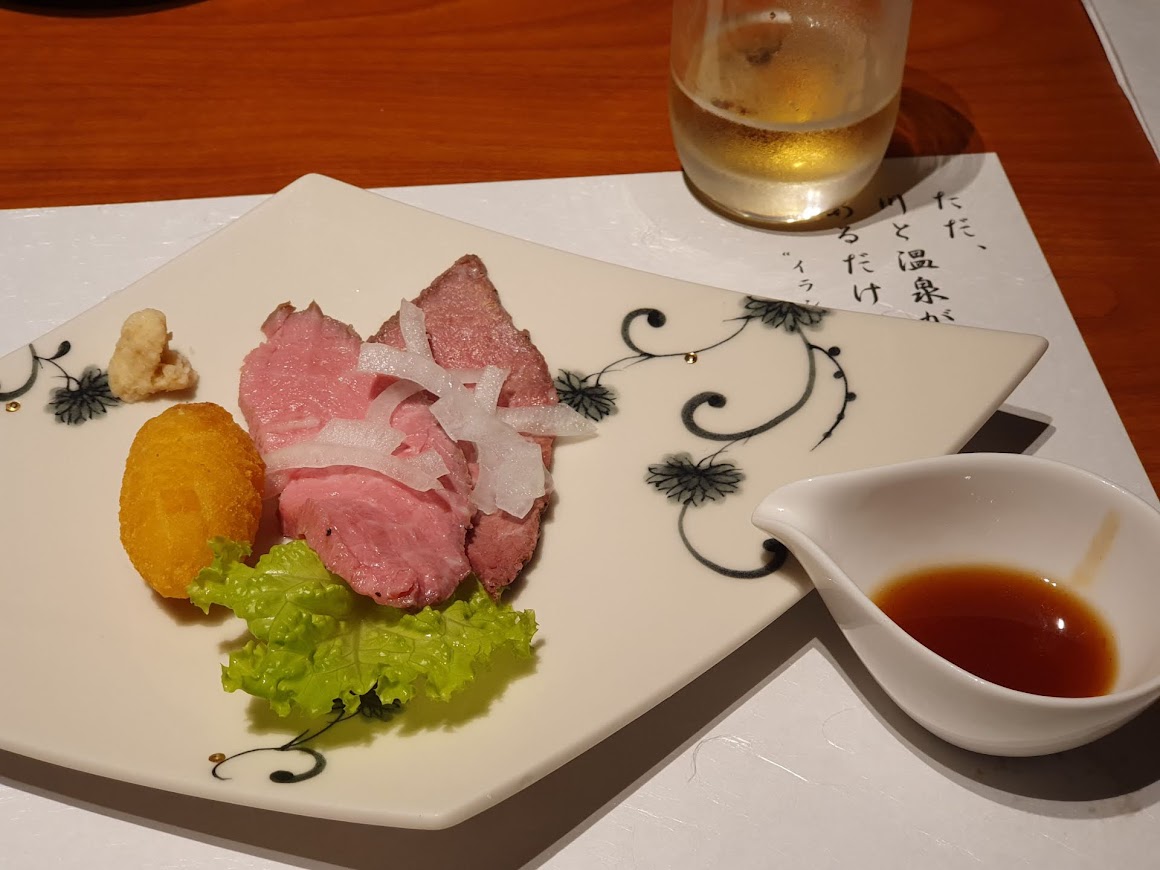
Roast beef with slice onions and gravy sauce.

Kotan hot pot (bouillabaisse) with local fish,   cabbage, soft white mushroom, tofu, potato cake and cheese sauce (to add to taste).
The menu also included some optional items for diners to choose. We could choose one of the following items:

  • Deep fried whole baby shrimps
  • Chilled chawanmushi
  • Chilled tomatoes

We were told to choose one item from the list. The waitress later told us we could choose 2 items! So we had the deep fried shrimps and the refreshing chilled chawanmushi.

Deep fried whole baby shrimps with paprika. This crunchy snack is delicious.

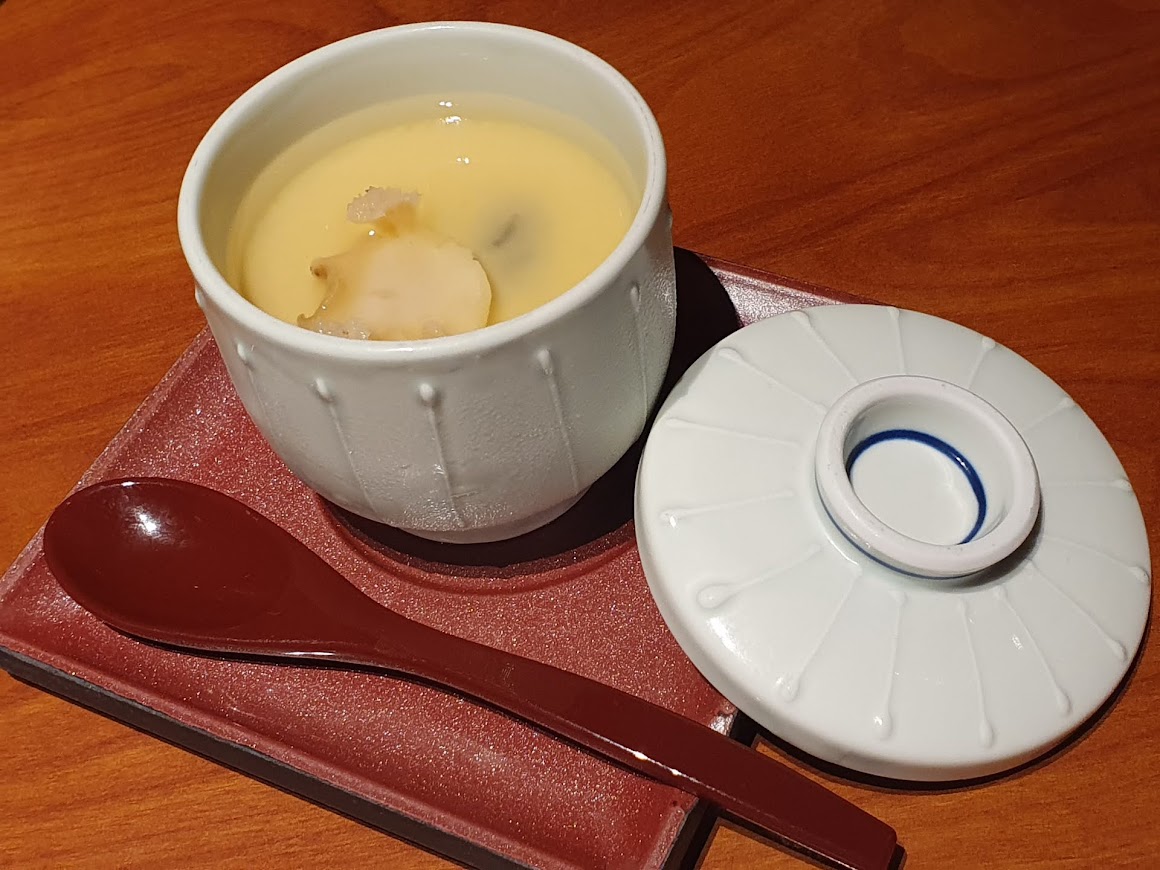
Refreshing Chawanmushi (Japanese savoury steamed egg custard) that was served chilled.

We could also choose one of the following “carbs” dishes:

  • Rice Curry with a choice of curry sauce - northern clam curry or cheese curry.
  • porridge with egg, green onions, cheese and pickles.
  • Udon noodle soup.

The guys chose the rice curry with northern clam curry sauce and my wife prefer something light, so she chose the Udon to share with us.

Dessert of custard and sorbet.

After dinner, we went to the lobby to get a cup of post-dinner coffee. The complimentary coffee from the self service machine was actually quite good.

As La Vista Akangawa is a small hotel, the lobby is quiet and peaceful. We could access the terrace with views of the river that is lit at night.

Lobby of La Vista Akangawa at night.

Cosy and quiet lounge area in the lobby.

My son prefers this as his post dinner drink, back in the room.

Morning walk at Lake Akan

I wanted to do an early morning walk along the shores of Lake Akan, including the Bokke Walking Trail, and was surprised that my son and wife were also keen to join me. The sun rise early at about 4 AM during this time of year, so we did not plan to see the sunrise.

We woke early and took a short drive to a free car park located in the middle of Akanko Onsen. From there, we took a short walk through the town to the shore of Lake Akan.

First view of Lake Akan.

Although there are many hot spring hotels along the shore of the lake, we were the only folks that are up and about at about 7 AM in the morning. The weather on this morning was like the day before. Although the sky was grey and cloudy, it was pleasant for a morning walk.

One of the many hot spring hotels along the shore of the lake.

From the cruise boat dock, we took a short 1.5 km hike on the Bokke Walking Trail.

Map showing our location and the trail along the shores of Lake Akan to the bokke (mud volcano) marked in orange.

The trail along the shore with views of the lake on one side and the forest on the other side.
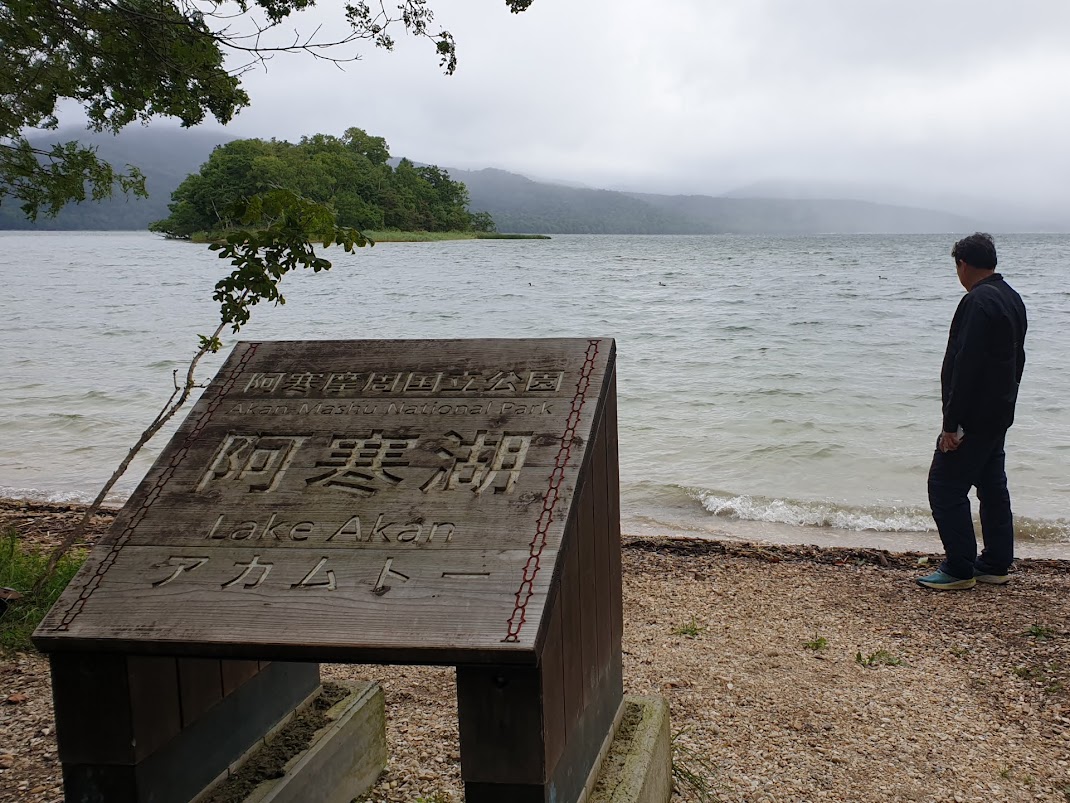
Taking a closer look at the “beach” at Lake Akan.

A recently uprooted tree along the trail.

The “bokke” is the highlight along this Bokke Walking Trail. Bokke means “boiling place” in the local indigenous Ainu language and it is a mud volcano where underground gases and water vapor push hot mud to the surface.

Information on the bokke. There are a few pools of boiling mud in this area, all fenced up for our safety.

We could see the bubbles coming up through the hot mud. There was also a faint smell of sulphur in the air.

After viewing the bokke, we took the trail that leads to the Akanko Eco Museum and then back to town.

A signboard warning about the dangers in the forest that included the Hokkaido  brown bears.

We saw a family of deer on our way to the Akanko Eco Museum. Probably the same herd that my wife saw when she did this walk a day earlier.

Overall, the walk along the shores of Lake Akan took about an hour. It was a good way to start the day and work up an appetite for breakfast at La Vista Akangawa.

Breakfast

For breakfast, guests at the La Vista Akangawa can choose from a Japanese-style set meal or a Western-style set meal. All of us chose the Japanese-style set meal, of course!

The dishes included chilled tofu, pickled  komatsuna (Japanese mustard spinach), jellyfish with sesame vinegar, Kushiro shishamo and grilled salmon, wasabi, pickles, long plate with cod roe, egg-roll, kneaded kelp roll, boiled potatoes, miso soup with mushrooms and grilled eggplant and Hokkaido Yumepirika branded rice.

The hotel also provided a hibachi grill on the table for us to warm up the shishamo and grilled salmon, which is a nice touch. The shishamo, laden with eggs, is a smelt native to Hokkaido.

Japanese breakfast at the La Vista Akangawa.

Warming up the shishamo fish on the Hibachi grill provided on the table. After grilling, the entire fish, from head to tail, tiny bones and all can be eaten.

We also have a choice of one of the following:

  • Nattō, a traditional Japanese food made from whole soybeans that have been fermented. I have tasted this before and did not like the slimy texture!
  • Hot spring egg (onsen tamago)
  • Trout Salmon Roe pickled in soy sauce.
  • Grilled seaweed

All of us chose the trout salmon roe pickled in soy sauce.

Although not shown, we all had dessert of haskap flavoured yogurt. We could also help ourselves to breakfast beverages (Hokkaido milk, juice, roasted green tea, tea and coffee) from a service counter.

We checked out soon after breakfast as we had a long drive ahead of us. From Lake Akan, our road trip continues to Otaru.

Overall, this is easily the best and most expensive hotel we stayed in during this road trip. Well worth the money we splurged as the hotel delivered value for the money.

Continue Reading »

Lake Onneto and trying the famous butadon at Obihiro

29 August 2023

Our road trip in Hokkaido continued on this day with a long drive, mostly on the expressways, from Lake Akan in the Akan Mashu National Park to Otaru. Otaru is a small harbor city located about 45 minutes drive northwest of Sapporo. The first part of our drive was from our hotel (La Vista Akangawa) in Akanko Onsen, via Ashoro, to Obihiro. I deliberately planned a lunch stop at Obihiro. Obihiro is the birthplace of the Buta-don (rice topped with strips of barbequed pork) and this dish is now famous worldwide!

We left La Vista Akangawa at about 9 AM, with the drive to Obihiro taking about 2 hours. The highway towards Ashoro would passed by the entrance to a slip road that leads to the start of the trail to Mount Meakan and also Lake Onneto.

Lake Onneto is a small lake at the foot of Mount Meakan, in the westernmost region of Akan-Mashu National Park. I have read that Lake Onneto is known as the "Lake of Five Colors." Depending on the weather conditions and time of day, the water appears to change in color from light blue through shades of green to dark blue.

I was debating with myself whether we should spent 30 minutes for a detour to see this lake as the weather was not good and we would probably be seeing something grey and disappointing.

Rather than regretting not going, I told my son who was driving to take the detour when we arrived at the junction of the slip road. It was the same familiar narrow road that we took a few days ago when we hiked up Mount Meakan. Lake Onneto is located just a few minutes further ahead of the trailhead.

Lake Onneto

There are parking spaces for just a few cars along the narrow road when we arrived at a wooden observation deck with unobstructed views of Lake Onneto. From here, visitors can view the lake and also see Mount Meakan and Mount Akanfuji in the background.

What we were supposed to see on the nice sunny day.

As expected, the sky and the lake were grey and there were low clouds shrouding Mount Meakan and Akanfuji.

What we saw at the observation deck at Lake Onneto. It was the same weather conditions that my son and I encountered when we hiked up to the summit of Meakan.

The observation deck at Lake Onneto. Note the narrow road leading to this place.

Although we did not get to see the fantastic views of Lake Onneto (and also Mount Meakan), I have no regrets. At least we can say that we had been here and done that. 

Butadon Pancho at Obihiro

Our next stop was a famous restaurant called the Butado Pancho in the city of Obihiro. There are a few popular restaurants in Obihiro serving this now famous dish such as Butahage, Tokaichi Butadon and Butadon Pancho.

I could only choose one. I selected Butadon Pancho mainly because this restaurant, founded in 1933, is known as the creator of this Hokkaido specialty.

Butadon Pancho’s opening hours are from 11.00 AM to 7.00 PM and there would be usually long queues at this popular eating place. I was planning to avoid the queue by going early, just after the restaurant opens.

We parked our car at the paid parking facility near the restaurant. There is a faint smell of BBQ pork in the air as we arrived at the restaurant at around 11.40 AM. Fortunately, there wasn’t a long queue on this day.

The queue outside Butadon Pancho when we arrived.

We had to register a name and number of persons in our group on a guest book at the entrance, and indicate if we are willing to share tables. There was also a sign that says that photography and videography is not allowed inside. Apparently, this is to discourage food bloggers and/or youtubers from wasting time creating social media content on the table, hence holding up the queue outside.

The queue moved rather fast and we did not have to wait long before we were shown to our tables. The restaurant is not very big, with seats for about 30 people. My wife and I took a small table while my son took another table next to us.

The menu is in Japanese. There is only one main course which is the butadon. We could choose the number of slices of pork that goes on top of the rice bowl and of course the prices vary based on the amount of meat. I understood a little of the kanji text and could recognise that there are 4 options with cryptic names as follows:

  • “Pine”, 950 Yen (with 4 slices).
  • “Bamboo”, 1050 Yen (with 5 slices).
  • “Plum”, 1150 Yen (with 6 slices).
  • “Flower”, 1350 Yen (with 8 slices).

Note: the number of slices is not indicated in the menu! I knew what the names meant from what I read about this restaurant.

We ordered the large (“Flower”) bowls of butadon with Coke to go with it. The food was served rather quickly.

The butadon was served with a bone china lid which could barely cover the 8 pork slices overflowing from the bowl of rice. Sitting on top of the delicious looking pork slices were green peas that do not add to the overall taste but definitely enhance the overall appearance of the dish.

Butadon with 8 slices of grilled pork and a side dish of yellow pickles.

The lid came in handy for me to temporarily place some of the pork slices on it while I attacked the remaining pork slices with the rice beneath. The pork is best eaten with the steamed white rice. The fragrant pieces of grilled pork is coated with a very tasty dark sauce that reminded me of the sauce on the unagi (Japanese grilled eel) dish.

Unlike beef, pork has to be well cooked. The texture of the pork would make or break this dish. Because Butadon Pancho uses the finest pork loin, the grilled pork pieces are tender. The little bit of fat on the meat adds to the flavour after grilling.

Overall, this was the first (and hence the best) Butadon I have eaten. I will definitely recommend visitors to try this dish when visiting or passing by Obihiro on your road trip.

Tip: go for the large bowl. You will never regret it.

Continue Reading »

Welcome to igoiseeishoot!

Thanks for visiting the igoiseeishoot blog. If you are visiting for the first time, you may want to start here.

This blog is where I share the places I have been to (I go), my experiences at these places, people I met, food I tried and things that fascinated me (I see) and memories of my travels and vacations with lots of photos (I shoot).

I hope you will enjoy reading the posts or find something useful in this blog.

I would love to hear your thoughts or feedback by email (igoiseeishoot@gmail.com) or dropping some lines into the comment boxes of the posts.

Stay connected with me on instagram.